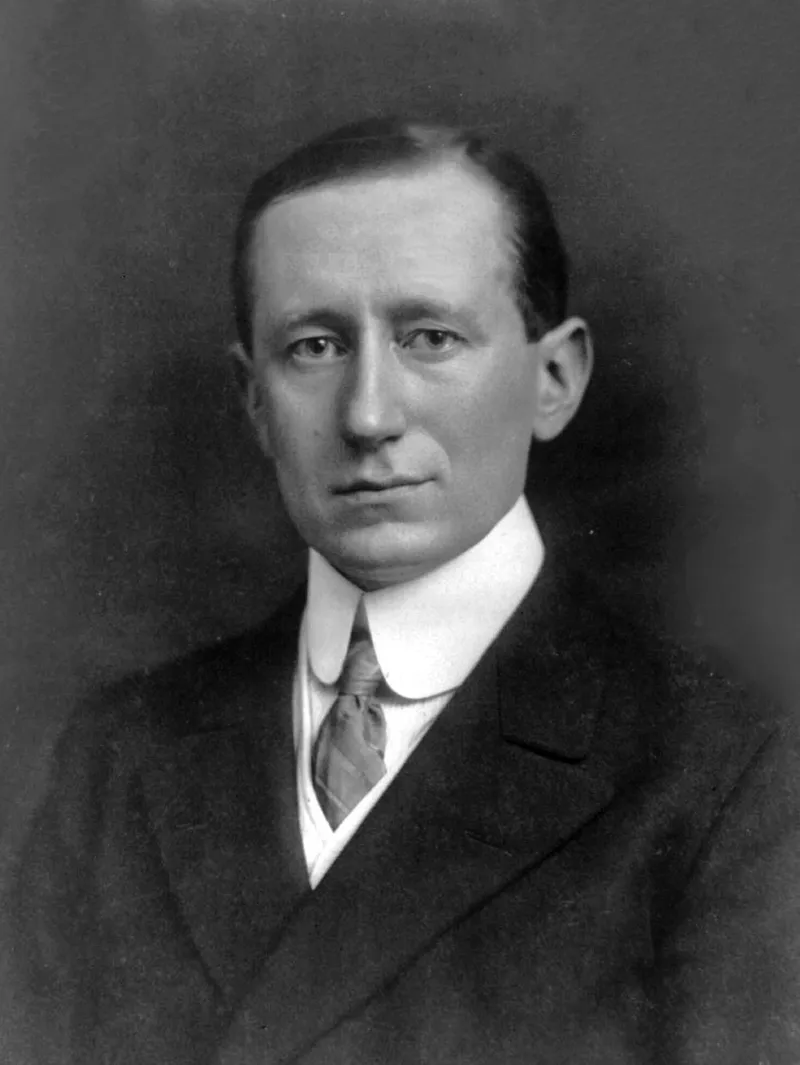
Guglielmo Marconi (1874–1937) was an Italian inventor and electrical engineer who developed, demonstrated, and commercialized the first practical wireless telegraphy system, earning the 1909 Nobel Prize in Physics. His work transformed global communication and laid the foundation for modern radio, television, and wireless technologies.
Early Life and Education
Marconi was born on April 25, 1874, in Bologna, Italy, the second son of Giuseppe Marconi, an Italian landowner, and Annie Jameson, daughter of an Irish whiskey distillery owner. His mixed heritage gave him connections to both Italian and British scientific communities that would prove valuable later.
As a boy, Marconi developed a keen interest in physics and electricity. He was privately educated at Bologna, Florence, and Leghorn, studying the works of James Clerk Maxwell, Heinrich Hertz, and other pioneers of electromagnetic theory. His experiments began in earnest in 1894, inspired by Hertz’s proof that electromagnetic waves could travel through space.
The Invention of Wireless Telegraphy
In 1895, Marconi began conducting experiments at his father’s country estate at Pontecchio. Using an elevated antenna (a crucial innovation), he succeeded in sending wireless signals over increasingly greater distances—first across a room, then across the estate, and eventually over hills beyond the line of sight[1].
Finding little interest from the Italian government, Marconi traveled to England in 1896, where he demonstrated his system to William Preece, Engineer-in-Chief of the British Post Office. That same year, he was granted the world’s first patent for a wireless telegraphy system.
In 1897, Marconi established the Wireless Telegraph and Signal Company (later Marconi’s Wireless Telegraph Company) and began demonstrating the commercial potential of his invention, including ship-to-shore communications.
The Transatlantic Triumph
Despite prominent scientists claiming that radio waves would not follow the Earth’s curvature, Marconi persisted with his plan for transatlantic communication. On December 12, 1901, at Signal Hill in St. John’s, Newfoundland, he received the letter “S” (three dots in Morse code) transmitted from Poldhu, Cornwall—a distance of over 2,100 miles[2].
This achievement, though initially controversial, proved that wireless communication across oceans was possible, opening the door to global telecommunications.
Nobel Prize and Recognition
In 1909, Marconi shared the Nobel Prize in Physics with Karl Ferdinand Braun “in recognition of their contributions to the development of wireless telegraphy”[3]. Braun had improved Marconi’s transmitter design to increase range and efficiency.
Life-Saving Technology
Marconi’s wireless technology proved its life-saving potential dramatically. In 1909, when the S.S. Republic collided with another vessel, the Marconi operator’s distress calls helped save over 1,700 lives. When the Titanic sank in 1912, wireless calls brought rescue ships to save 700 survivors. Afterward, international regulations required ships to carry wireless equipment.
Later Work and Legacy
Marconi continued innovating throughout his life. In 1931, he demonstrated the first microwave radiotelephone link between Vatican City and the Pope’s summer residence. In 1935, he conducted early experiments demonstrating principles of radar.
Marconi died in Rome on July 20, 1937. Radio stations around the world observed two minutes of silence in his honor. His work created an industry and established wireless communication as an essential part of modern life—from broadcast radio and television to cellular phones and Wi-Fi.
Sources
- Nobel Prize. “Guglielmo Marconi – Biographical.” His early experiments and development of wireless telegraphy.
- Britannica. “Guglielmo Marconi.” Details of the transatlantic transmission.
- Nobel Prize. “The Nobel Prize in Physics 1909.” Nobel citation and recognition.