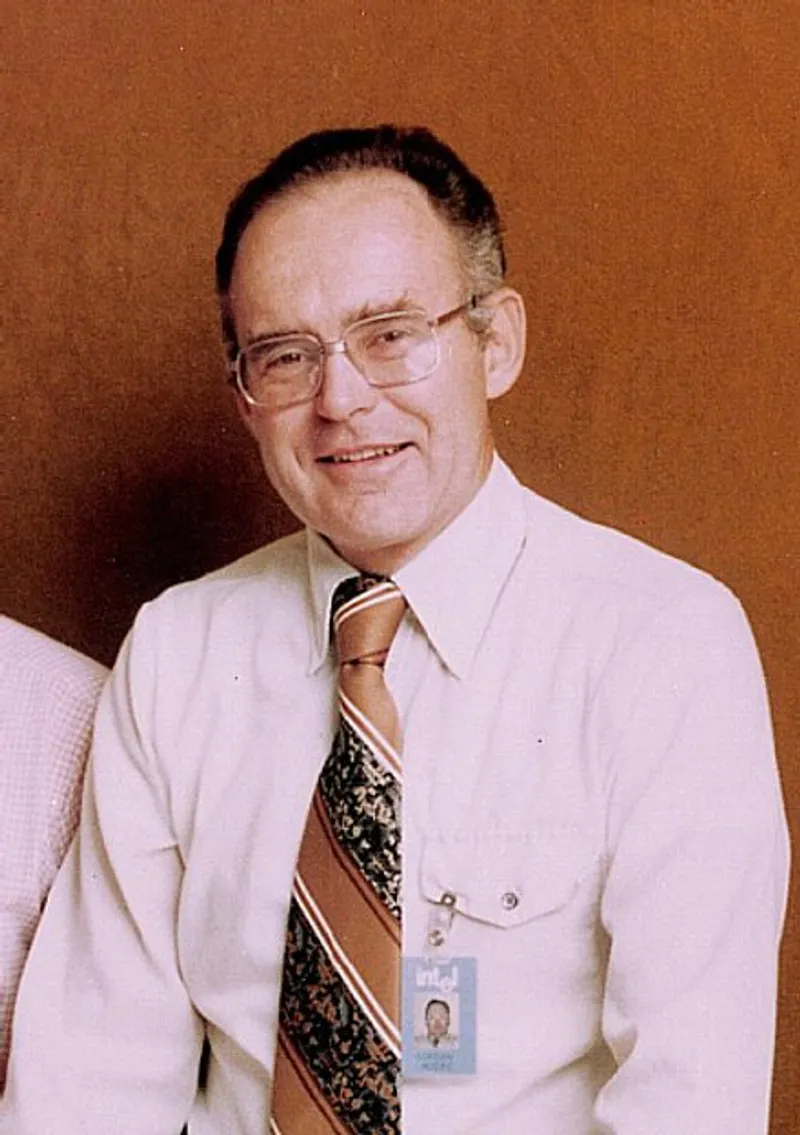
Gordon Moore (1929–2023) was an American businessman and engineer who co-founded Intel and predicted the exponential growth of computing power. Moore’s Law, his observation about transistor density, became a self-fulfilling prophecy that guided the semiconductor industry.
Fairchild Semiconductor
Moore was one of the “Traitorous Eight” who left Shockley Semiconductor in 1957 to found Fairchild Semiconductor. At Fairchild, he helped develop the integrated circuit manufacturing processes that made modern chips possible.
Moore’s Law
In 1965, Moore observed that the number of transistors on integrated circuits was doubling roughly every year (later revised to every two years). This observation, known as Moore’s Law, predicted the exponential increase in computing power that transformed society.
Founding Intel
In 1968, Moore and Robert Noyce left Fairchild to found Intel. Moore served as CEO from 1979 to 1987 and chairman until 1997. Under his leadership, Intel became the dominant microprocessor company.
Impact of Moore’s Law
Moore’s Law was more than prediction—it became a target. The semiconductor industry organized around maintaining the pace Moore predicted:
- Manufacturing roadmaps planned years ahead
- Investment in R&D to meet expected density targets
- Economic planning assumed continued progress
Philanthropy
Moore and his wife donated billions to environmental conservation, science, and education through the Gordon and Betty Moore Foundation. He remained modest about his achievements, saying Moore’s Law was just an observation that happened to be useful.