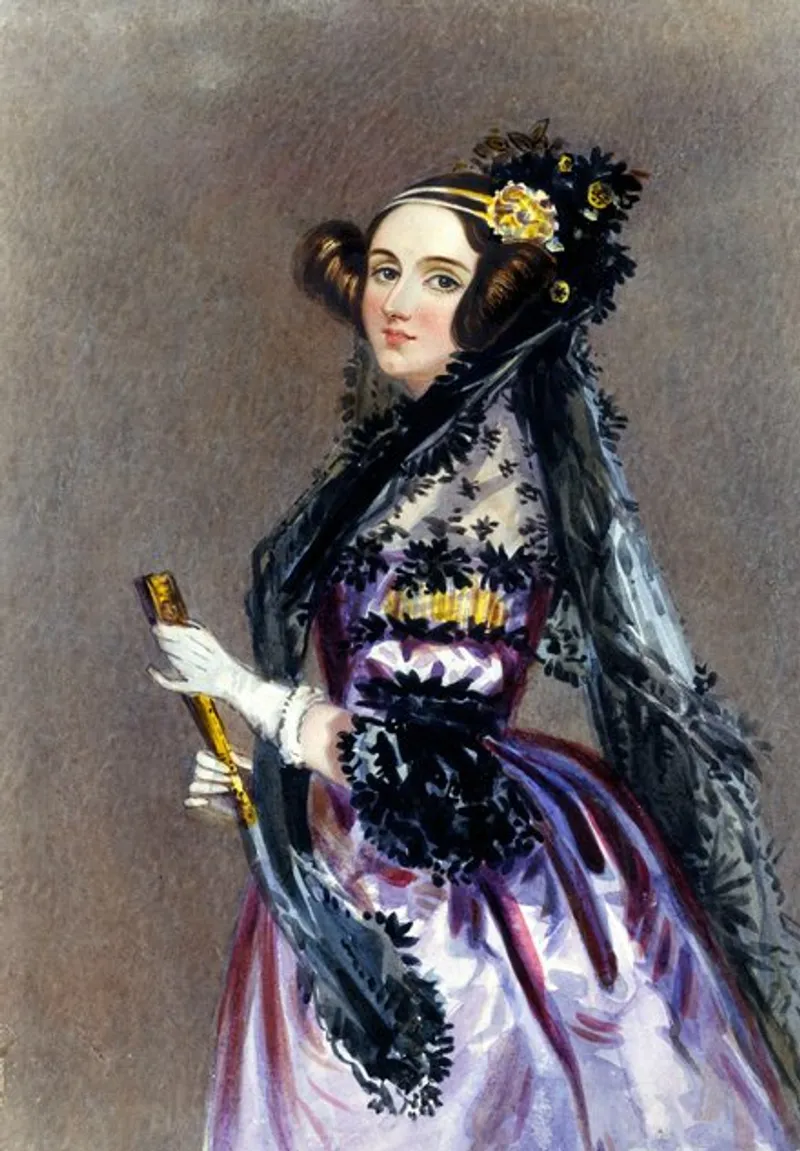
Augusta Ada King, Countess of Lovelace (1815–1852), known as Ada Lovelace, was an English mathematician and writer. She is celebrated for her work on Charles Babbage’s proposed Analytical Engine, where her extensive notes included what is recognized as the first algorithm intended for implementation on a computer.
Early Life and Education
Ada was the only legitimate child of the poet Lord Byron and mathematician Anne Isabella Milbanke. Her parents separated a month after her birth, and Byron died when Ada was eight. Determined that Ada would not inherit her father’s volatile temperament, her mother ensured she received a rigorous education in mathematics and science—unusual for women of that era.
Ada showed early aptitude for mathematics and was tutored by some of Britain’s finest minds, including Mary Somerville, who introduced her to Charles Babbage in 1833.
Meeting Babbage
At a party in 1833, the seventeen-year-old Ada witnessed a demonstration of Babbage’s Difference Engine and was captivated. She and Babbage formed a lasting intellectual friendship, with Babbage later calling her “The Enchantress of Number.”
Ada’s mathematical training and imaginative thinking made her uniquely suited to understand the theoretical implications of Babbage’s machines—implications that sometimes eluded Babbage himself.
The Notes
In 1842, Italian mathematician Luigi Menabrea published a French article describing the Analytical Engine based on Babbage’s lectures in Turin. Ada was commissioned to translate it into English.
Her translation, published in 1843, included seven extensive notes labeled A through G that were three times longer than the original article[1]. These notes transformed a technical description into a visionary exploration of computing.
Note G: The First Program
Note G contains a detailed algorithm for computing Bernoulli numbers—a sequence important in mathematics. This algorithm is considered the first computer program because it describes a complete set of instructions for a general-purpose computing machine[2].
While Babbage contributed to the mathematical work, historian Stephen Wolfram notes that “there’s nothing as sophisticated—or as clean—as Ada’s computation of the Bernoulli numbers.”
Visionary Insights
Ada saw further than anyone of her time into computing’s potential:
Beyond numbers: She recognized that the Engine could manipulate any symbols, not just numbers: “The engine might compose elaborate and scientific pieces of music of any degree of complexity or extent.”[3]
The limits of machines: She also articulated a fundamental truth about computers: “The Analytical Engine has no pretensions whatever to originate anything. It can do whatever we know how to order it to perform.” This observation anticipated debates about artificial intelligence by over a century.
Legacy
Ada Lovelace died of uterine cancer at age 36, the same age as her father at his death. Her contributions were largely forgotten until the mid-20th century, when computer pioneers rediscovered her notes.
Today she is recognized as a founding figure of computer science:
- The U.S. Department of Defense named the Ada programming language (1980) in her honor
- Ada Lovelace Day, held annually in October, celebrates women in STEM
- Her vision of computing beyond calculation anticipated the digital age by a hundred years
Sources
- Wikipedia. “Ada Lovelace.” Documents the scope of Ada’s notes relative to Menabrea’s article.
- NIST. “Ada Lovelace: The World’s First Computer Programmer.” Describes Note G and its significance.
- Max Planck Society. “Ada Lovelace and the first computer programme.” Quotes Ada’s vision of machines composing music.